A yes or no generator gives you a random answer to a simple question. Type a question if you like, press the button, and the tool returns Yes or No with equal odds, or Yes, No or Maybe. It also plays best-of-3, 5 or 7 rounds. It is a game, not advice.
Last updated: 26 October 2026
Sample answer shown. Press Get answer for your own.
How to use the yes or no generator
Write your question in the box if you want it shown above the answer; leaving it empty works just as well. Under Answers, pick Yes or No for a coin-flip decision, or Yes, No or Maybe when you want a neutral outcome as well. Rounds sets how the answer is reached. A single flip gives one result. Best of 3, 5 or 7 keeps flipping until one answer has won more than half of the rounds, and the sequence of flips appears under the answer.
Tick Keep history to see your last 20 answers on the page, copy the current answer with one tap, and clear the list whenever you like. Nothing is saved: the history lives only on the page and disappears when you leave it, and no question or answer is sent to a server.
How fair is a random yes or no answer?
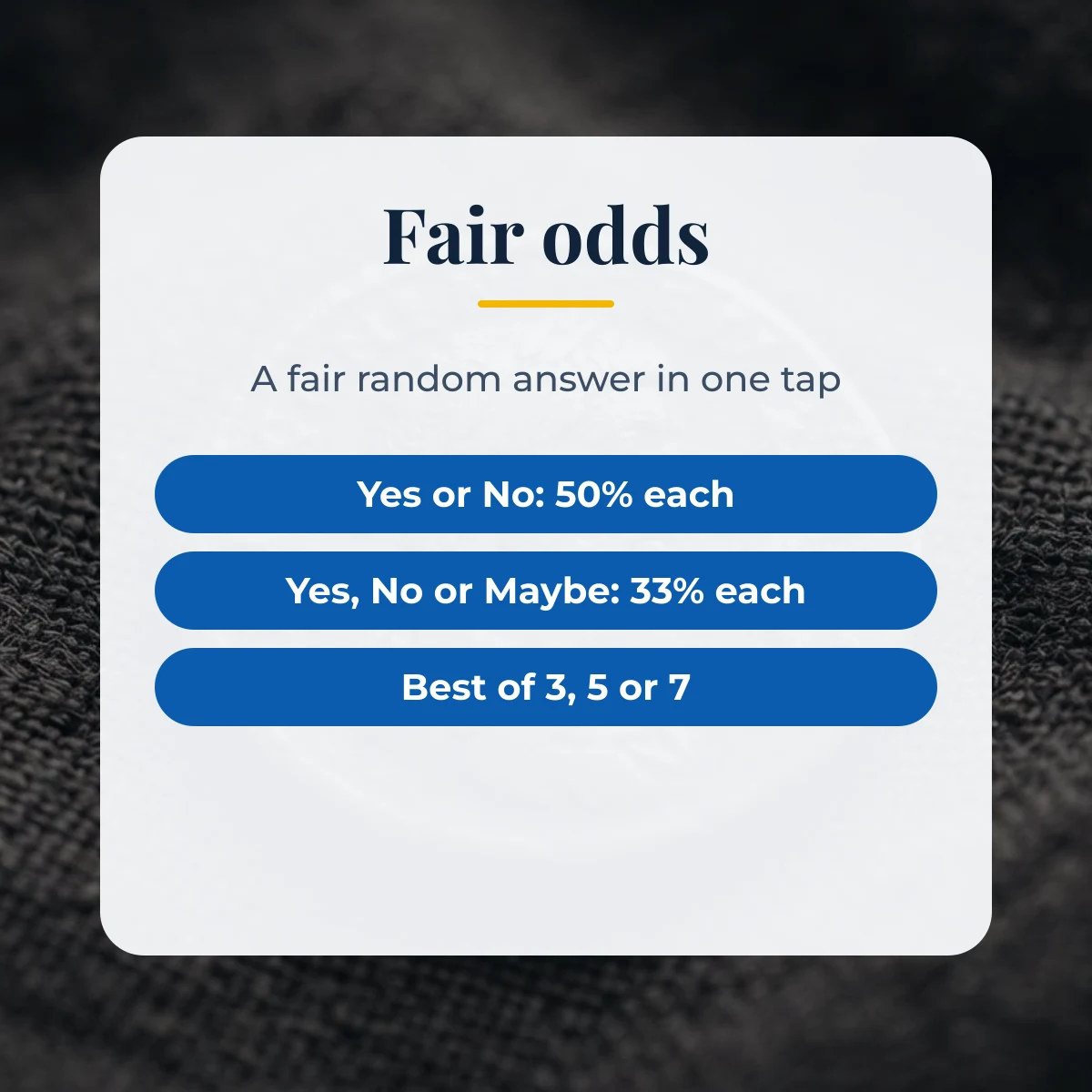
Fairness comes from the source of the random numbers. The tool uses the cryptographic random generator built into your browser rather than a simple formula, and it throws away values that would tilt the odds towards one side. Each flip is independent: a run of three yeses does not make a no more likely next time. The table shows the chance of each answer in every mode.
| Mode | Outcomes | Chance of each answer | How the result is reached |
|---|---|---|---|
| Yes or No, single flip | Yes, No | 50% each | One random draw |
| Yes, No or Maybe | Yes, No, Maybe | About 33.3% each | One random draw from three outcomes |
| Best of 3 | Yes, No | 50% each overall | First answer to win 2 rounds |
| Best of 5 | Yes, No | 50% each overall | First answer to win 3 rounds |
| Best of 7 | Yes, No | 50% each overall | First answer to win 4 rounds |
Streaks are normal in random answers
People often distrust a random tool when it repeats itself, but repeats are part of how chance works. With a fair 50/50 flip, any chosen answer appears twice in a row a quarter of the time and three times in a row one time in eight. If you get Yes four times running, that is not a fault, because it happens about once in every sixteen sequences of four.
| One chosen answer in a row | Chance with a fair 50/50 flip |
|---|---|
| 2 times | 25% |
| 3 times | 12.5% |
| 4 times | 6.25% |
| 5 times | 3.125% |
| 6 times | 1.5625% |
When a random yes or no answer helps
A random answer is useful when the options are close and the choice is small: who goes first in a game, which film to watch tonight, whether to order takeaway. It breaks the deadlock so you can move on. A useful trick is to notice how you feel about the result. If you find yourself hoping for the other answer, you have learned what you wanted. For anything that affects health, money or safety, use real advice rather than chance. More free utilities like this one are on the SoShareIT Tools home page.
Yes or no generator FAQ
Is the yes or no answer really 50/50?
In Yes or No mode each answer has an equal chance. The tool asks your browser for random numbers from the Web Crypto interface and discards values that would favour one side, so there is no built-in bias. Previous answers do not affect the next one.
What does Yes, No or Maybe mode do?
It adds a third outcome, so each answer has a one in three chance. Use it when you would rather have a neutral result sometimes than be forced into a side.
How does best-of-3 or best-of-5 work?
The tool keeps flipping until one answer has won more than half of the rounds. In best-of-3 that is two wins, in best-of-5 three wins, and in best-of-7 four wins. Every flip is shown in the history.
Should I use this to make important decisions?
No. It is a game and a tie-breaker for small, low-stakes choices such as what to eat or who goes first. For decisions about health, money or safety, rely on proper advice rather than a random result.